
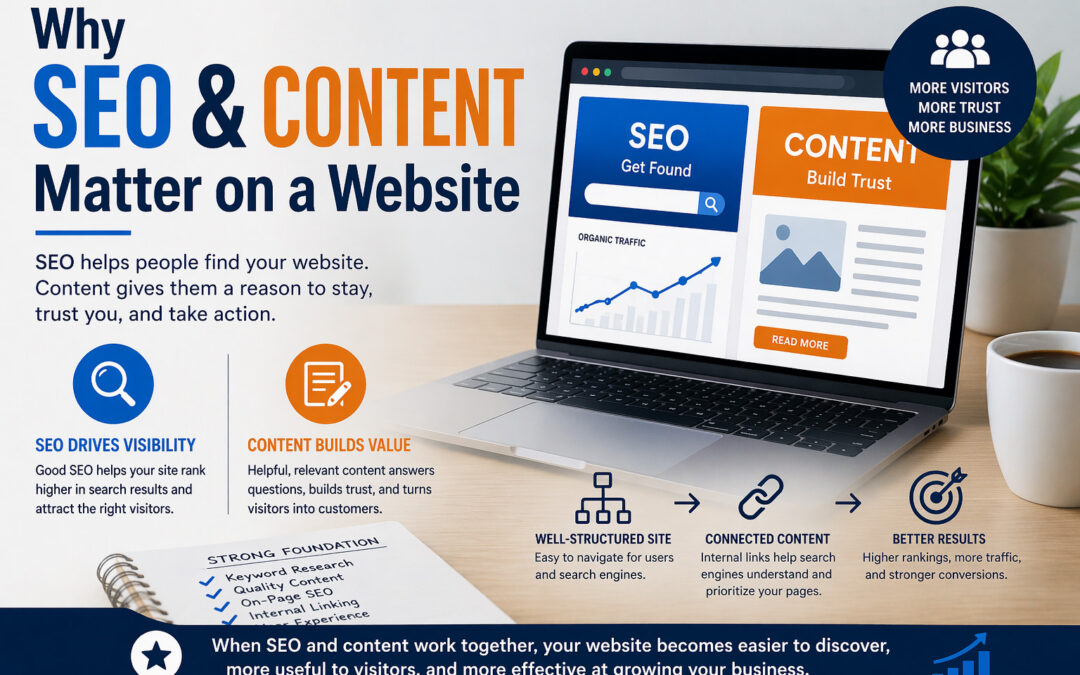
A website can look polished and still underperform. If people cannot find it in search, or if the content does not clearly answer their questions once they arrive, the site will struggle to generate meaningful business results. Google’s SEO Starter Guide explains that SEO helps search engines understand your content and helps users find your site through search, while Google’s people-first content guidance emphasizes creating helpful, reliable content for real users rather than content designed mainly to manipulate rankings. (Google for Developers)
That is why SEO and content should never be treated as separate parts of a website. SEO without strong content gives search engines very little of value to surface. Content without SEO often goes unseen, even when it is useful. The most effective websites combine both by creating valuable content and organizing it so search engines and users can easily understand what the site is about, how pages relate to one another, and where to go next. (Google for Developers)
SEO Brings Visibility. Content Builds Trust.
SEO matters because it improves visibility. It helps your website appear when people search for services, products, or answers related to your business. Google recommends using descriptive titles, headings, alt text, and link text so search engines can better understand your pages and users can better judge whether your content matches what they need. (Google for Developers)
Content matters because ranking is only the beginning. Once a visitor lands on your site, your content must quickly show relevance, authority, and usefulness. Google’s current guidance continues to stress helpful, reliable, people-first content and says success comes from creating unique, satisfying material that fulfills people’s needs. (Google for Developers)
When SEO and content work together, your website becomes more than a digital brochure. It becomes a system that attracts qualified visitors, builds confidence, and guides people toward action. That is where real website performance comes from. (Google for Developers)
Your Website Should Be Structured Around Topics, Not Random Pages
One of the biggest mistakes businesses make is treating a website like a collection of unrelated pages. A stronger approach is to structure the site around clear topics. Google recommends making it easy for users to move from general content to more specific content, and modern SEO guidance supports organizing websites around pillars, clusters, and logical internal relationships between pages. (Google for Developers)
In practical terms, this means your homepage should introduce your brand and direct visitors toward your main service or product areas. Each core service or category should then have its own dedicated page. Supporting content such as blog posts, FAQs, guides, and case studies should expand on those core topics and link back to the most relevant main pages. This makes your site easier to understand, easier to navigate, and stronger in search. (Google for Developers)
Use Topic Clusters Instead of Random Blogging
Publishing blog posts without a plan is one of the most common content mistakes. A better model is the topic cluster. Semrush defines topic clusters as groups of related pages built around a main subject, while pillar pages serve as central overview pages that link to more specific supporting content. (Semrush)
This structure works because it builds topical depth. Instead of scattering articles across unrelated themes, you create a central page for an important business topic and then support it with related articles that answer narrower questions. That helps readers explore your expertise more naturally, and it helps search engines understand that your site covers the subject in a meaningful, organized way. (Semrush)
For example, if your website offers website improvement services, you might create a main page for Website Improvement. Supporting articles could cover conversion problems, mobile usability, page speed, homepage messaging, and checkout friction. Together, those pages form a stronger structure than a series of disconnected blog posts. This is the kind of organization that supports both SEO and conversion. (Semrush)
Internal Linking Is Part of the Strategy
A strong content structure depends on internal linking. Google states that links should be crawlable and descriptive, and internal links help search engines discover pages and understand how those pages connect. Semrush also notes that orphaned pages and pages with too few internal links can limit visibility because search engines have a harder time finding and prioritizing them. (Google for Developers)
That means every important page on your website should be connected through a logical linking structure. Your navigation should link to your most important pages. Core service pages should link to supporting articles. Blog posts should link back to the service pages they support. Related articles should also link to one another where it makes sense for the reader. (Semrush)
Internal linking is not just a technical detail. It is part of how you signal page importance, improve usability, and keep visitors moving through the site. A page with no meaningful internal links is much more likely to be overlooked by both users and search engines. (Semrush)
Every Page Should Have a Clear Job
The best websites assign a clear role to every page. Some pages are meant to rank for broad, high-intent search terms. Some are meant to answer specific questions. Some are meant to convert visitors into leads or customers. Google’s SEO guidance emphasizes descriptive titles and headings because they help clarify what a page is about and who it is for. (Google for Developers)
This is where good structure becomes practical. Your homepage should communicate your overall value and point visitors to your key services. Your service pages should target your main commercial topics. Your blog should support those services with deeper, more specific articles. Your about page, testimonials, case studies, and contact page should reinforce credibility and help convert interest into action. (Google for Developers)
When every page has a job, your content becomes easier to manage and your site becomes easier to grow. You stop publishing for the sake of publishing and start building a system that supports visibility, authority, and conversion. (Google for Developers)
How to Structure the Content on Each Page
Site structure matters, but page structure matters too. Each page should focus on one main topic, use a clear title, include a strong main heading, and organize supporting information under logical subheads. Google specifically recommends using words people would search for in titles, headings, alt text, and other descriptive elements. (Google for Developers)
A well-structured page is easier to read and easier to understand. Visitors should be able to scan it quickly and still grasp the core message. That means concise sections, descriptive subheads, clear calls to action, and internal links to related content when readers want to go deeper. Strong structure improves user experience while reinforcing SEO at the same time. (Google for Developers)
A Simple Structure That Works for Most Business Websites
For most business websites, a practical SEO and content structure looks like this: a homepage, an about page, core service or product pages, supporting trust pages such as testimonials or case studies, a blog or insights section, and a clear contact or inquiry page. The blog should not operate as a separate content island. It should support the core commercial pages by answering the exact questions your ideal customer is likely to search for. (Google for Developers)
A simple way to think about it is this: your main pages sell, your supporting pages explain, and your blog expands reach. When these parts are connected properly, your website becomes stronger in search and more persuasive to human visitors. (Semrush)
Final Thoughts
SEO and content are not optional extras. They are part of the foundation of an effective website. SEO helps people discover your site. Content helps them trust it. Structure helps both search engines and users understand it. Google’s current guidance continues to point in the same direction: create helpful, reliable, people-first content and organize your website so it is clear, useful, and easy to navigate. (Google for Developers)
A well-structured website does more than improve rankings. It makes your business look clearer, stronger, and more credible. It helps the right people find you, understand what you offer, and take the next step with confidence. (Google for Developers)